

Remote monitoring is defined as the continuous observation, management, and control of systems, networks, and devices from a remote location using software and connected hardware. For business owners and IT managers, this technology is the difference between catching a server failure at 2 a.m. before it becomes a crisis and discovering it when employees cannot log in at 9 a.m. Remote monitoring and management (RMM) platforms like SolarWinds Dameware Remote Everywhere give IT teams centralized visibility across every endpoint, server, and network device without requiring physical presence. The result is faster response, lower downtime, and a security posture that works around the clock.
What is remote monitoring in business and IT?
Remote monitoring is the practice of using software agents, IoT sensors, and cloud dashboards to collect real-time data from systems and devices and act on that data without being on-site. The industry term for the IT-specific version is Remote Monitoring and Management, or RMM. Both terms describe the same core idea: watch everything, respond fast, and fix problems before users notice them.
RMM platforms manage networks, servers, and endpoints from a single console, automating patching and scripts to reduce downtime. That single-pane-of-glass approach is what separates modern IT management from the old model of dispatching a technician every time something breaks. Tools like SolarWinds Dameware Remote Everywhere provide centralized device management that improves both security and uptime simultaneously.
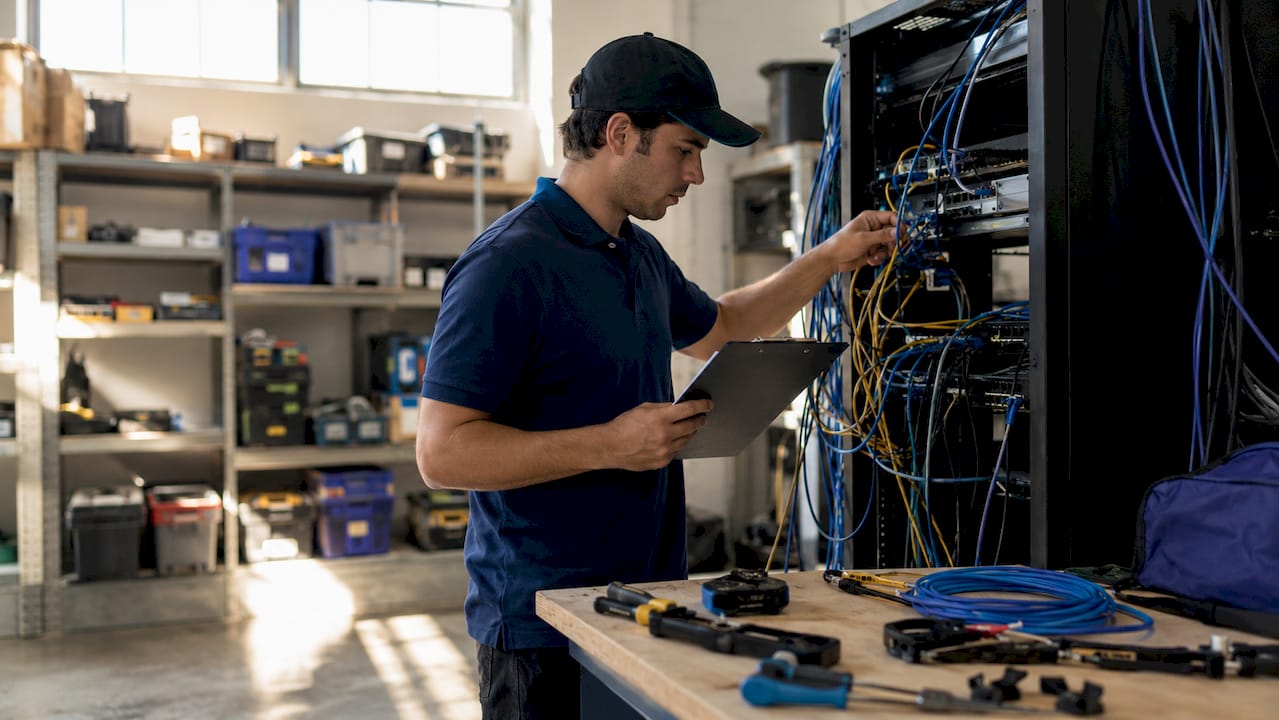
Remote monitoring technology applies well beyond IT. Industrial facilities use IoT sensors to track equipment temperature, vibration, and output. Healthcare providers use FDA-cleared wearable devices to track patient vitals between appointments. The common thread is continuous data collection feeding into a platform that alerts the right person when something needs attention.
How does remote monitoring work?
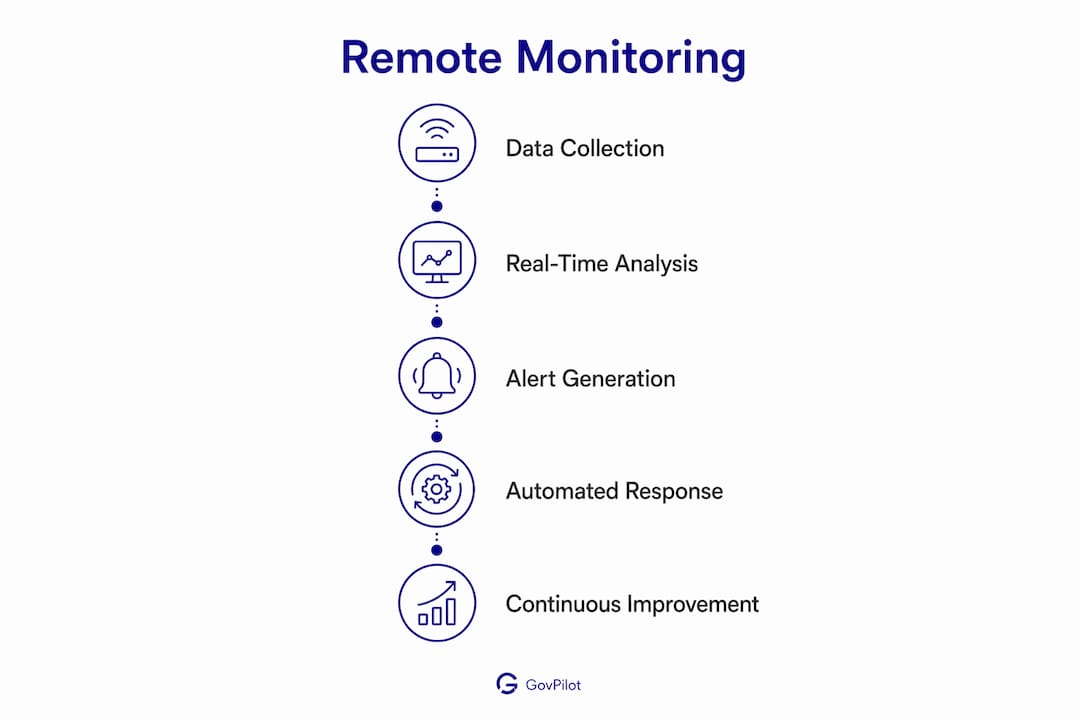
Remote monitoring works through four sequential steps: data collection, transmission, analysis, and alerting.
- Data collection. Software agents installed on endpoints, servers, and network devices gather performance metrics continuously. In industrial settings, physical IoT sensors measure temperature, pressure, vibration, and flow rates.
- Transmission. Collected data travels over the internet or a private network to a central cloud platform or on-premises server. Connectivity modules handle the handoff between the sensor or agent and the processing layer.
- Analysis. The platform compares incoming data against predefined thresholds and historical baselines. Anomalies trigger automated rules or machine learning models that classify the severity of the issue.
- Alerting and response. When a threshold is crossed, the system sends an alert to the IT manager or triggers an automated remediation script. RMM platforms can patch a vulnerable endpoint or restart a failed service without human intervention.
Integration with existing IT systems is where most deployments succeed or fail. An RMM platform that does not connect to your ticketing system, SIEM, or ERP creates yet another silo. Unified analytical platforms connecting ERP, MES, and IoT prevent alert fatigue by routing all signals into one place. That integration is not optional. It is the mechanism that turns raw data into decisions.
Pro Tip: Set alert thresholds based on your actual operational baselines, not vendor defaults. Default thresholds generate noise. Calibrated thresholds generate signal.
What are the main benefits of remote monitoring solutions?
The core benefit of remote monitoring is proactive maintenance. Automated scripting and patch management actively prevent issues without human intervention, replacing the traditional break-fix model entirely. That shift matters because most downtime is predictable. A disk filling up, a certificate about to expire, or a service consuming abnormal CPU are all visible days before they cause an outage.
The operational and security benefits extend across every part of the business:
- Reduced downtime. Automated patching and real-time alerts catch failures before they cascade.
- Improved cybersecurity. Centralized endpoint visibility means IT managers see every device on the network, including those that have not been updated.
- Faster troubleshooting. Remote access tools let technicians diagnose and resolve issues in minutes rather than hours.
- Compliance support. Continuous logging creates audit trails that satisfy requirements from HIPAA, CMMC, and other regulatory frameworks.
- Cost control. Fewer emergency dispatches and shorter incident resolution times reduce labor costs.
- User satisfaction. Employees experience fewer disruptions, which directly affects productivity.
In healthcare, remote patient monitoring reduces hospitalization frequency and shortens stays for patients with chronic conditions. That outcome translates directly to cost savings for health systems and better quality of life for patients. The operational intelligence generated by continuous monitoring is the asset. The alerts are just the delivery mechanism.
The industrial sector is moving further. The industry is shifting from visible monitoring to operational intelligence that enables autonomous equipment anomaly resolution. Machines are beginning to fix themselves. That is not a future trend. It is happening now in manufacturing plants that have invested in connected sensor networks and analytics platforms.
What are common examples of remote monitoring across industries?
Remote monitoring solutions look different depending on the industry, but the underlying architecture is consistent. The table below shows how the technology maps across three major sectors.
| Industry | Purpose | Typical tools |
|---|---|---|
| IT management | Endpoint, server, and network oversight | SolarWinds Dameware, RMM platforms |
| Industrial operations | Equipment performance, anomaly detection | IoT sensors, SCADA systems, MES dashboards |
| Healthcare | Patient vital sign tracking between visits | FDA-cleared wearables, RPM platforms |
IT remote monitoring and management
IT teams use RMM platforms to manage thousands of endpoints from a single console. The platform deploys software agents to every device, collects health metrics, and automates routine maintenance like patch deployment and script execution. For small businesses without a large internal IT team, this is the practical equivalent of having a technician watching every machine simultaneously. Symmnet uses this model to deliver 24/7 monitoring for clients in manufacturing, aerospace, and professional services without requiring an on-site IT presence.
Industrial remote monitoring
Industrial remote monitoring uses physical IoT sensors attached to equipment to track performance metrics in real time. A manufacturing line might monitor motor temperature, conveyor belt speed, and hydraulic pressure simultaneously. When a sensor reading drifts outside the normal range, the system flags it before the equipment fails. Securing manufacturing networks is an added layer of this work, since connected industrial equipment creates new attack surfaces that require the same attention as IT endpoints.
Remote patient monitoring in healthcare
Remote patient monitoring (RPM) is a specific application of remote monitoring technology in clinical care. FDA-cleared devices must transmit data at least 2 days per 30 days for billing eligibility under CMS guidelines. That requirement reflects how seriously regulators treat the continuity of data collection. RPM programs show the best results when integrated with care management and virtual clinical teams rather than deployed as standalone technology.
What cybersecurity risks come with remote monitoring?
Remote monitoring platforms are prime targets for cyberattacks precisely because of how much access they hold. RMM tools function as cornerstone cybersecurity elements because they control network and endpoint access privileges across every managed device. An attacker who compromises an RMM console does not just access one machine. They access all of them.
RMM consoles require multi-factor authentication and strict access controls to prevent attackers from gaining extensive privileges. MFA alone is not enough. Role-based access controls should limit each user to only the systems they need to manage. Audit logs should capture every action taken through the console so anomalies are detectable. For manufacturers, these controls also support compliance in manufacturing operations by creating the documentation trail regulators require.
Alert fatigue is the second major risk. When a monitoring platform generates hundreds of low-priority alerts daily, IT managers begin ignoring them. That is when real threats slip through. The solution is not fewer alerts. It is smarter alert configuration tied to business-critical thresholds and integrated into a single dashboard rather than scattered across multiple tools.
Pro Tip: Treat your RMM platform with the same security rigor as your firewall. Audit access permissions quarterly, rotate credentials after any staff change, and review alert rules every six months to remove noise.
Key takeaways
Remote monitoring delivers its full value only when deployed proactively, secured tightly, and integrated across all operational data sources rather than run as an isolated tool.
| Point | Details |
|---|---|
| Definition is precise | Remote monitoring is continuous observation and management of systems from a distance using agents, sensors, and cloud platforms. |
| Proactive beats reactive | Automated patching and real-time alerts prevent failures before users experience them, replacing the break-fix model. |
| Security is non-negotiable | RMM consoles require MFA and role-based access controls because compromising one grants access to all managed devices. |
| Integration determines effectiveness | Connecting RMM to ERP, ticketing, and SIEM systems prevents alert fatigue and turns data into decisions. |
| Applications span industries | IT management, industrial operations, and healthcare all use remote monitoring with different tools but the same core architecture. |
Why most businesses underestimate remote monitoring
The most common mistake I see is treating remote monitoring as a reactive crash-fix tool. Business owners hear "monitoring" and picture someone watching a screen waiting for a red light. That mental model is wrong, and it leads to underinvestment in configuration and integration.
The real value is in what happens before the red light appears. A well-configured RMM platform patches endpoints on a schedule, flags certificate expirations weeks in advance, and detects unusual network traffic patterns that a human reviewer would miss entirely. The engine room is not stalling. It is running quietly because someone set it up to prevent stalling in the first place.
The second thing I have learned is that remote monitoring without integration is just expensive noise. I have seen businesses deploy solid RMM platforms and still suffer outages because the alerts were going to an inbox nobody checked. Connecting monitoring data to your ticketing system, your on-call rotation, and your security information platform is what makes the investment pay off.
Cybersecurity diligence is the third pillar that gets skipped. The same platform giving you visibility into your network is a high-value target for attackers. Locking it down with MFA, auditing access quarterly, and reviewing alert rules regularly is not optional maintenance. It is the baseline. The businesses that treat their RMM console like any other SaaS tool are the ones that end up in breach reports.
— Michael
How Symmnet supports your remote monitoring needs
Symmnet delivers managed IT services built around 24/7 remote monitoring and management for small businesses that cannot afford unplanned downtime.
Symmnet's managed IT services include RMM deployment, endpoint security, firewall management, and proactive patch management, all under a fixed monthly price. Clients in West Covina and San Gabriel rely on Symmnet for real-time visibility into their networks without building an internal IT team. The service covers compliance documentation, security hardening, and helpdesk support so your team stays focused on operations. If you want to know where your IT gaps are before they become incidents, Symmnet offers a free assessment to identify risks and opportunities across your infrastructure.
FAQ
What is remote monitoring used for in IT?
Remote monitoring in IT is used to track the health and performance of endpoints, servers, and networks from a central platform. It automates patching, detects anomalies, and reduces downtime without requiring on-site technicians.
How does remote monitoring work for small businesses?
Small businesses use RMM platforms with software agents installed on every device. Those agents send performance data to a central dashboard, where automated rules trigger alerts or fixes when something falls outside normal parameters.
What is the difference between remote monitoring and remote access?
Remote monitoring continuously collects and analyzes system data to detect issues. Remote access is the ability to control a device directly. RMM platforms combine both, using monitoring to identify problems and remote access to resolve them.
Why use remote monitoring for cybersecurity?
Remote monitoring gives IT managers centralized visibility into every endpoint, making it easier to detect unauthorized access, unpatched vulnerabilities, and unusual network behavior before they escalate into breaches.
What are examples of remote monitoring in healthcare?
Remote patient monitoring uses FDA-cleared wearable devices to transmit vital signs data to clinical teams between appointments. CMS requires at least 2 days of data transmission per 30-day period for billing eligibility under Medicare guidelines.